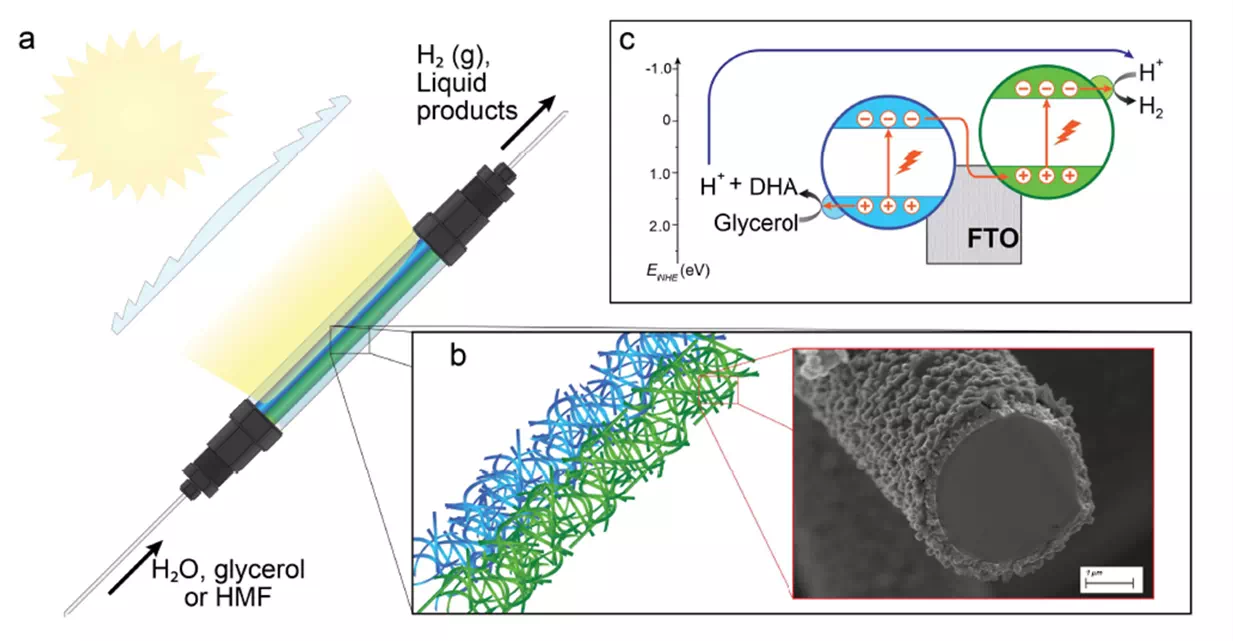
The team achieved a major milestone by successfully demonstrating tandem operation of hydrogen-evolving and oxidising particle sheets in a Z-scheme configuration.
By evaluating the onset potentials of both hydrogen-evolving particle (HEP) and oxidising particle (OP) sheets, the team identified energetic limitations in the initial system and developed countermeasures including charge transport layer and co-catalyst optimisation. This resulted in:
- Improved energetic alignment between HEP and OP
- A transition from microampere to milliampere-level tandem photocurrent densities
- Stable operation for over one hour under simulated bias-free conditions
These results confirm, for the first time within PH2OTOGEN, that the developed materials can work together towards bias-free solar hydrogen production and glycerol valorisation in a Z-scheme configuration. This represents a critical step towards integration into the photocatalytic flow reactor demonstrator.
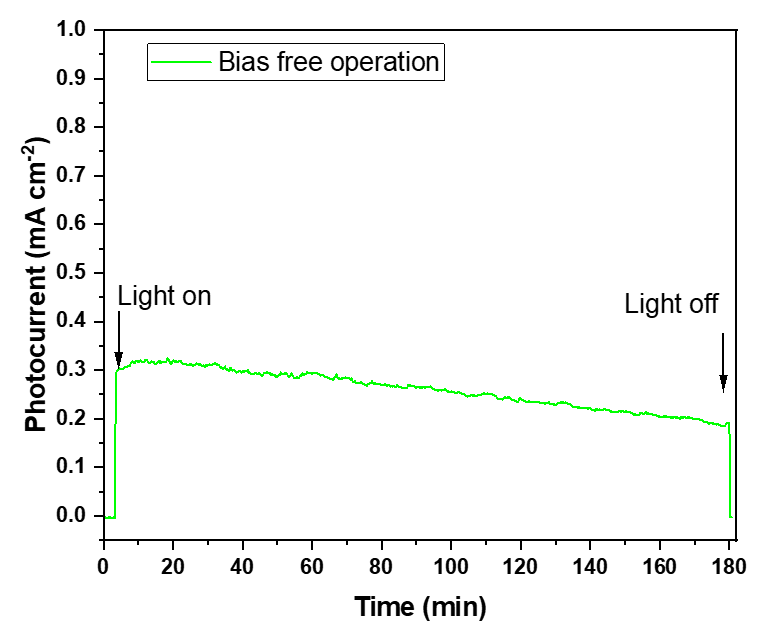
Photograph of photoabsorbers during tandem testing; bias-free photocurrent measurements
The first tandem operation was on non-optimised, conventional substrates. In particular, the titanium felt used for the BiVO4 was not transparent so the first testing was done in a parallel configuration (i.e. the photoabsorbers were placed side-by-side).
In the next phase of the project, we will focus on the transfer of the semiconductor growth onto the transparent porous conductive support (an fluorine-doped tin oxide coated quartz felt).
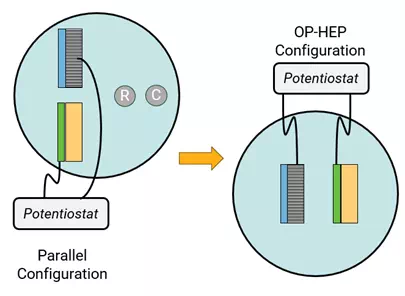
Beyond the scientific breakthrough, this achievement validates the strategy pursued across the project and directly supports the next development phase: transitioning to transparent conductive substrates and scaled system integration.
In parallel with the material development in 2025 we have also been designing and engineering a photocatalytic reactor that is compatible with the unique photocatalyst sheet architecture that is proposed in the PH2OTOGEN project. In particular, we have focussed on how to position the photocatalyst sheet to maximise the active surface area and defining the operating parameters, such as electrolyte flow, to maximise product removal from the surface. In 2026, we will carry out tandem trials both in the three-electrode laboratory set-up and the reactor to validate it before the testing phase that will begin in 2027.